
Medication Costs: Starting the Conversation With Your Patients
Jason Kwan, PharmD ACN Population Health Pharmacist Non-adherence to medications for common chronic conditions such as diabetes contribute to more than $8 million per year in avoidable hospitalization costs for every 100,000 lives in a 2015 study completed by Healthentic.1 In the Truven Health Analytics survey in 2017 with ~3000 participants, the number one reason why respondents did not fill…
Click to view a larger image.
Jason Kwan, PharmD
ACN Population Health Pharmacist
Non-adherence to medications for common chronic conditions such as diabetes contribute to more than $8 million per year in avoidable hospitalization costs for every 100,000 lives in a 2015 study completed by Healthentic.1 In the Truven Health Analytics survey in 2017 with ~3000 participants, the number one reason why respondents did not fill their new prescription was cost (67%). 10% of respondents reported stopping taking their medications due to cost. In addition, 29% of the respondents did not inform their provider they had stopped taking their medication.2 Cost of medications is a concern for both providers and patients, impacting both patients’ health and quality of life.
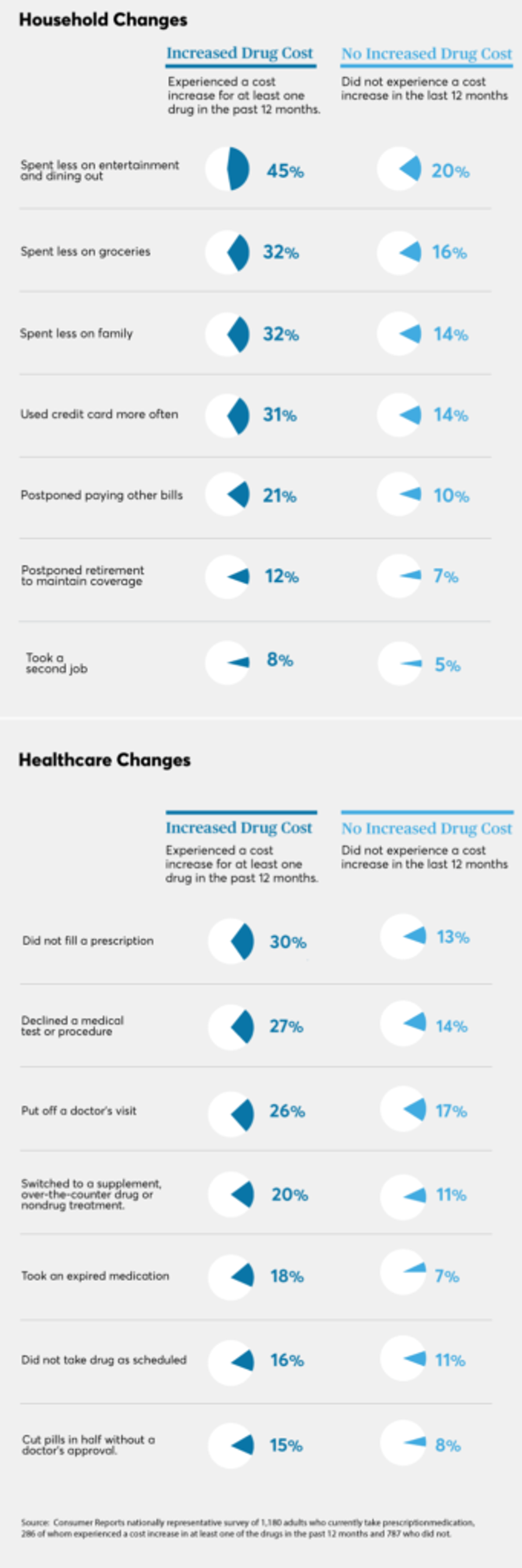
In a Consumer Reports survey of ~1200 participants, high cost medications affect both the household and healthcare sought (image to right).3
In a Consumer Reports telephone poll, 63% of respondents did not find out the price of the medication until they were at the pharmacy.4 Cost should become a part of the conversation during the office visit due to the implications of not only medication adherence, but quality of life.
Initiating the conversation about high medication costs
Encourage patients to shop around for their prescription drugs if medication cost is a concern. Prescribing generics over brands is an effective strategy to lower medication costs. If clinically equivalent alternatives cannot be prescribed, there are some situations where paying cash may be less than the medication copay. A study by USC in 2013 found 1/4 of filled pharmacy prescriptions had a patient copay greater than the average insurance reimbursement by more than $2. The average overpayment for generic prescriptions (28%) was $7.32 and $13.46 in brands (6%). In those situations, it may be worth it to ask the pharmacy for their cash price.5 Consumer Reports compared cash prices of five commonly prescribed generics among different pharmacies (image below).6 The downside for paying a prescription by cash is the patient may not be able to apply it to their deductible.
Download a one-sheet of resources for your patients (pdf)
Sources
- https://healthitanalytics.com/news/cost-is-a-primary-driver-of-medication-non-adherence-rates
- http://truvenhealth.com/Portals/0/Assets/TRU_18156_0617_NPR_Poll_Prescription_Drugs_FINAL.pdf
- https://www.consumerreports.org/drug-prices/how-to-pay-less-for-your-meds/
- https://www.consumerreports.org/drugs/doctors-and-rx-prices-ending-the-silence/
- https://healthpolicy.usc.edu/research/overpaying-for-prescription-drugs/
- https://www.consumerreports.org/drug-prices/shop-around-for-better-drug-prices/
